Monday, March 10, 2014

Ron Paul - Ukraine, Russia, and a debt-ridden US

Submitted by Ron Paul via The Ron Paul Institute,
Officially, US debt stands at more than $17 trillion. In reality, it is many times more. The cost of the US invasion of Afghanistan and Iraq may be more than six trillion dollars. President Obama’s illegal invasion of Libya cost at least a billion dollars and left that country devastated. The costs of US regime change efforts in Syria are likely thus far enormous, both in dollars and lives. That’s still a secret.
So who in his right mind would think it is a good time to start a war with Russia over Ukraine? And worse, who would commit the United States to bail out a Ukraine that will need at least $35 billion to survive the year?
Who? The president and Congress, backed by the neocons and the so-called humanitarian interventionists!
The House voted overwhelmingly last week to provide $1 billion in loan guarantees to Ukraine. That is just the beginning, you can be sure. But let’s be clear: this is not money for the population of that impoverished country. The Administration is sending a billion dollars from US taxpayers to wealthy international bankers who hold Ukrainian debt. It is an international bank bailout, not aid to Ukrainians. And despite the escalating anti-Russia rhetoric, ironically some of that money will likely go to Russia for Ukraine’s two billion dollar unpaid gas bill!
So what happened in Ukraine? The US government and media claims that the US must save Ukrainian democracy from an invading Russian army that is threatening the country’s sovereignty. But in reality the crisis was instigated in part by US meddling. Remember the intercepted telephone call in which two senior Obama Administration officials discussed plans to replace the elected government in Ukraine with US puppets? That is exactly what happened. Is that not a violation of Ukraine’s sovereignty? Is that what democracy is all about?

The Obama Administration’s policy toward Ukraine is hypocritical. The overthrow of the government in Kiev by violent street protests was called a triumph of democracy, but when the elected parliament in autonomous Crimea voted last week to hold a referendum to decide its future, President Obama condemned it as a violation of international law. What about the principle of self-determination, which is also enshrined in international law?

I have long thought that a referendum to reorganize Ukraine into a looser confederation of regions might help reduce tensions. I still believe this could help, but it seems the US government is not so enthusiastic about democracy when there is a chance for an outcome it opposes.
I strongly believe that Crimeans have every right to transfer sovereignty over their peninsula to Russia if they wish. The only question that remains is whether there will there be an honest election, and I don’t see any reason there can’t be.
The US government tells the rest of the world, “We want you to be good democrats and have elections,” but if they don’t elect the right people then we complain about it and throw them out, like we did in Egypt. In Crimea they want to have an election to determine their future. President Obama condemned those plans for a vote by saying, “We are well beyond the days when borders can be redrawn over the heads of democratic leaders.” Does he not remember that the authorities in Kiev were installed just weeks ago after a US-backed coup against the Ukrainian constitution?
Congress next week will likely vote for sanctions against Russia. Though many mistakenly believe that sanctions are a relatively harmless way of forcing foreign countries to do what we say, we should be clear: sanctions are an act of war.

Cooler heads in the United States are not currently prevailing. There is a danger of an unimaginable conflict between the US and Russia. We must demand a shift away from a war footing, away from incendiary rhetoric. We are broke and cannot afford to “buy” Ukraine. We certainly cannot afford another war, especially with Russia!

globalization and imbalances


Money is a store of value and a medium for exchange. Globalization, the race to the bottom, and the resulting concentration of wealth is deflationary because it produces an overabundance of savings and investment. The profits (in excess of those due to productivity gains) are simply excess debt taken on by consumers due to a lack of labor bargaining power in the race to the bottom. These types of excess profits were in essence garnished wages that have already been spent and will likely never be repaid. The 'wealth' is illusory and those debt instruments such as MBS, student loans are not worth 100 cents on the dollar. Companies are fooling themselves in thinking their savings in many outstanding debt instruments, including the US dollar, is a good store of value. CEOs will get paid due to these above average profits, albeit illusory and will not suffer in the one year when the market falls out.

Not sure who DvD was on Pettis' blog but this guy is spot on:
  
Weak aggregate demand, falling labor share of GDP globally, rising debt load, rising inequalities and global currency war are all the inevitable outcomes of globalisation as implemented for the past couple of decades.
According to the International Labor Organization, there were 1.56bn people working in industry and services in the world in 2000 (i leave agricultural employement aside voluntarily). In 2013, they were 2.14bn people employed globally.
Of the 1.56bn global workers in 2000, 424m were in developped countries and 1.13bn in developping countries
World population was 6.1bn in 2000 so 26% employment to population ratio
Say the 424m workers in developped countries earned an annual wage of $35k on average in 2000. That’s an annual income of $14.8 Tr
Say the 1.13bn workers in developping countries earned an annual wage of $5.5k on average in 2000. That’s an annual income of $6.2 Tr
That’s a global wage income of $21 Tr compared to world nominal GDP of $33.3 Tr, ie. a labor share of 63%
Of the 2.14bn global workers in 2013, 458m were in developped countries and 1.68bn in developping countries
World population is estimated at 7.1bn in 2013 so 30% employment / population ratio, higher than in 2000
Say the 458m workers in developped countries earned an annual wage of $45k on average in 2013 (+2% p.a. since 2000). That’s an annual income of $20.6 Tr
Say the 1.68bn workers in developping countries earned an annual wage of $11.7k on average in 2013 (+6% p.a. since 2000). That’s an annual income of $19.7 Tr
That’s a global wage income of $40.3 Tr compared to world nominal GDP of $75 Tr, ie. a labor share of 54%
I should make it clear that i don’t have exact statistics for median wage level for all countries, i’m simply using realistic orders of magnitude derived from individual countries wage level for illustration purposes. Certainly, the above back of the envelope calculation is consistent with the observation of declining labor share globally. Please let me know if you have more reliable median wage numbers.
So, in the last 13 years, labor share of GDP has shrunk materially despite higher employment / population ratio. This is due to labor arbitrage by corporations, which have pocketed the difference. Profit share of GDP has increased by the same extent as labor share has decreased. That’s where wealth inequality come from. The 1% of people in the world indexed on the profits of the top 2000 global companies are doing very well. This is amplified by the policy response consisting of offsetting lagging wage income by financial and residential asset price inflation through artificially low interest rates (the infamous “wealth effect”). So the higher corporate profits as a share of GDP are valued at a higher multiple thanks to a lower cost of capital. Home owners are richer in money terms, even though they live in exactly the same home in real terms.
If labor (consumption) share is decreasing, capex share must increase, which it has in developped countries in 2003-2006 and in developping countries in 2009-2011, resulting in overcapacity and pricing pressure in many industries globally. Now, we are at the point where capex share can’t increase much more, so net exports share must increase, which explains the on-going currency war as everybody scrambles for export surplus against everybody else. Of course, net exports add up to zero globally, by definition. If neither consumption share, nor capex share, nor net exports share can increase, then growth must slow.
Decreasing labor share, industrial overcapacities and competitive devaluations are combining into global deflationary pressures.
Meanwhile, global debt is exploding. Developped countries consumers make more purchases on credit because of lagging income. Governments in most places try to stimulate spending by infrastructure programs. Governments in developped countries have to provide social safety nets to the unemployed and the poor. Corporates in emerging markets have financed large capex progams by debt, which has been greatly facilitated by easy credit in surplus countries able to redeploy their reserves (developped countries Sovereign debt) through their own domestic fractional reserve banking system in a piling up of debt upon debt (literally speaking). Households in developping markets are borrowing more to buy real estate, often at rapidely inflating prices. Corporates in developped markets have found it a good idea to leverage high operating profits with cheap debt so as to further enhance return on equity. Finally, margin debt, carry trades and derivatives are used everywhere to fund positions in financial risk assets as the central banks put make it seem safe to pursue inherently risky yield enhancement strategies. Large financial players can anyway count on a bailout come the next crisis so they may as well enjoy the asymetric risk / reward (head, i win ; tail, taxpayer lose).
More wealth for the few, more debt for everybody else as the concentration of economic profits and the socialization of economic losses go to extremes. The wealth divide is reaching a point where it is now fueling tensions. Equity values are rising fast despite rising debt in a very unstable equilibrium (equity being junior to all debt, rising debt should normally compress equity values). There is a global race to debase currencies all against the others to each defend / gain competitiveness to try to keep the domestic social situation under control.
So, indeed it seems to me that globalization, as implemented over the past couple of decades, has reached a dangerous deadend. Monetary policies employed to extend that deadend a bit further are only making the situation more precarious as financial instability risks coumpouding sluggish economic developments.
The G20 is nowhere on these issues. It is not surprising as most officials from the G20 and related multilateral institutions are the same guys who pushed for and implemented globalization and financial liberalization over recent decades. They will be the last ones to admit it has not worked out as expected. Remember, trade liberalization was supposed to be mutually beneficial as per Ricardo comparative advantages theory ; financial liberalization was supposed to be advantageous as capital would be free to invest in the best projects. Actual developments are contradicting these well-meaning theories, to say the least as unemployment increase globally (6% in 2013 accoding to the ILO), debt load increase exponentially and a huge amount of investment turns out wasted. So, unable or unwilling to comprehend the huge gap between the ideals of their globalization agenda and the actual experience, the G20 is left with using the right words in their communiques to reassure the people and the markets while no changes whatsoever are contemplated to the dysfunctional world trade and monetary system.
One idea proposed already in the 1990′s by French Nobel Economic Laureate Maurice Allais to avoid such a situation would be to radically reform the current WTO framework and have free trade within regions large enough so as to ensure competitive markets but of similar living standards so as to avoid labor arbritrage and its weakening impact on aggregate demand. This is taboo as systematic propaganda has ensured that groupethink associates free trade with growth and protectionism with recession, despite the evidence of a weakening growth trend and the occurence of ever more severe economic and financial crisis since over the past 17 years as globalization accelerated.

Monday, March 3, 2014

The United States of Zombie Banks

prevent deflationary spiral and depression

1) prop up banks, serve as lender of last resort
2) eliminate FASB 157 mark to market on Level 3 assets, return to mark to fantasy
3) purchase toxic assets and by purchase i mean buy them at more than they were worth and then let the banks pay the difference between fantasy and real price, later i.e. fines etc (at gov't discretion)
4) make sure assets that Fed purchases dont' lose money; MBSs and all paper backed by houses etc must not lose money so manipulate market:
house purchasing holiday i.e. salex tax credit for new homeowners
lower Fed rate->lower mortgage lending rates->pull forward housing demand

What happened since 2009 is a deep recession, followed by modest recovery in a disinflationary environment

By bailing out Fannie Mae, Freddie Mac, banks, homes are able to be kept off the market and sold slowly as to maintain an artificially high sale price and low inventory. if a reset would've been allowed to happen debt holders would have taken a hit but a healthy housing market would have been created with disposable income going to other sectors of the economy. Instead, OER (owner equivalent rent) is shooting higher and hedge funds such as Blackrock, and the GSEs (fannie freddie) have cornered people seeking housing into choosing between an overpriced home or and overpriced rental. This is a price control over a basic human necessity, housing, to bailout banks and the government at the expense of the rest of the economy. Higher prices, fewer buyers, that's ok banks and GSEs have 0% borrowing and thus can hold onto assets/inventory forever, no need to liquidate.

To fight disinflation ex-housing the solution is more lending and more debt?


In its attempt to reflate asset prices at all costs, and succeeding with both the stock market and new housing bubble if not so much wages and the broad economy, the Fed has made housing unaffordable for the vast majority of the population (confirmed further by the plunge to 15 year lows in mortgage applications), forcing Americans to scramble for rental housing, sending rents to all time highs. This can be is seen in the OER. The problem is that with so much of monthly discretionary spending going to rental, it means there is far less in free cash flow available to be used for other purchases. Which also means that inflation away from rents is declining and getting lower with every month almost as a result of the surge in rents!

Monday, February 24, 2014

unleash the Kraken

When alpha predators (certain underwater dinosaurs) eliminated all other predators in their ecosystem they turned on themselves, since they were the only competition left. Predatory lending by US banks to foreign countries has been going on for decades (or longer) but now this greedy (or desperate) US banking cartel is turning on its own citizenry once again:

Subprime car-loan borrowing:
"Those with non-prime credit ratings—or credit scores between 620 and 679—had the highest average auto loan. For these borrowers, the average new car loan rose more than $1,500, to a new high of $29,385.  Not surprisingly, those with subprime credit ratings—credit scores between 550 and 619—had the highest average monthly payment, of $499."

Subprime student-loan lending: "We've been taking whatever we can for student loans every year, taking whatever we have left over and using it to stock up the freezer just so we have a couple extra months where we don't have to worry about food," says Mr. Matherne, who owes $51,600 in federal loans. 

Although the amount spent this way may be small, some estimates at $221M it's the malinvestment in a second rate education, a degree thats' not in demand, or simply failing to attend classes--those are the true losses that student loan borrowers will face.

last week banks ramped up subprime lending and now this week "Eight of the nation's largest banks will be able to use their own models and systems to calculate the amount of capital they need to set aside for risk- weighted assets, according to a source familiar with the situation."

Graph of Excess Reserves of Depository Institutions (DISCONTINUED SERIES)

MOAR Lending! Bring on the subprime aka "another chance mortgage"


The banks receiving approval for their models are JPMorgan Chase, Citigroup, Goldman Sachs, Morgan Stanley, Northern Trust, State Street, Bank of New York Mellon and U.S. Bancorp. The changes will take place in the second quarter.
The source said at least 10 other U.S. banks are in line to have their models approved, as the rule they are complying with applies to all U.S. banks with more than $250 billion in assets and a global presence. The other banks have not received approval yet as their models have not been running for the last two years.
The rule on how to model for capital was finalized in 2007, and in July 2013 regulators said at a minimum the banks would have to hold 7 percent Tier 1 capital, which primarily entails common stock and reserves. The source said that under the banks' own models, they will all hold more than the 7 percent minimum and that broadly speaking all eight banks have currently meet or exceed that level.

There is a coordinated effort to generate inflation. The FED has run out of ammunition to fight disinflation (many think this happened as soon as the FED funds rate hit .25% or 0%). An austerity obsessed Republican House has largely limited discretionary or non-automatic fiscal policy to affect inflation. As a credit bubble deflates in China and turmoil hits emerging markets, the possibility of another depression increases, with central banks without ammo and gridlocked governments.

We'll see in a few months how this plays out but it seems the US gov't via the US banking cartel is asking the US to borrow like it's 2007 to provide demand while the globe withers or crashes.


We must accelerate the race to the bottom or terminate it and/or have a painful reset.

There must be more faith in the value of labor and certainty in its future cash flow and a reduction in the value of hoarding or saving. Higher wages for those with higher marginal propensity to consume will drive demand and trading of real goods (vs financial assets, repurchasing shares, all under mark-to-fantasy accounting).

Saving represents consumption delayed and increasingly it seems there is a thing as too much saving, especially in individuals, groups, or institutions with a low propensity to consume/spend. In the great depression, you hear mostly about individuals causing a run on banks, in this economic environments institutions, UHNW individuals, corporations, and companies are hoarding and causing a run on labor demand which feeds into a vicious circle, reducing wages, reducing demand, and encouraging further hoarding, cost cutting, etc. The psychopathic fear of another global depression is leading inorexably towards that very thing. as with money, trade is based on trust and confidence, and as worldwide confidence in its institutions and a brighter tomorrow has faded, so as the willingness to trade and invest for the future.

the search for yield & malinvestment:
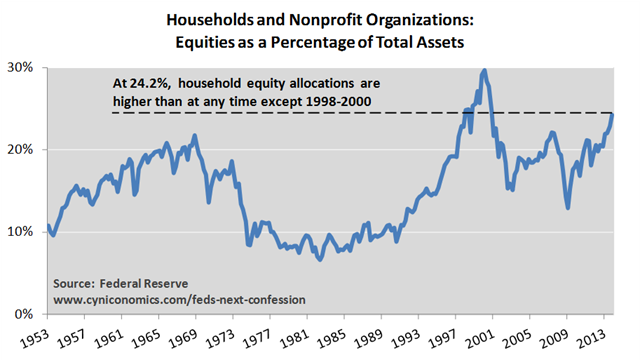
feds next confession


Friday, February 14, 2014

another chance mortgage aka subprime

So far few other big banks seem poised to follow Wells Fargo's lead, but some smaller companies outside the banking system, such as Citadel Servicing Corp, are already ramping up their subprime lending. To avoid the taint associated with the word "subprime," lenders are calling their loans "another chance mortgages" or "alternative mortgage programs."

Friday, January 31, 2014

Corporate Welfare - Walmart

"“Despite a holiday season that delivered positive comps, two factors contributed to lower comp sales performance for the 14-week period for Walmart U.S. First, the sales impact from the reduction in SNAP (the U.S. government Supplemental Nutrition Assistance Program) benefits that went into effect Nov. 1 is greater than we expected.


All forms of stealing are deflationary. Stealing cuts into the average citizen’s disposable income, it reduces how much he can buy. Because there are now fewer dollars chasing more goods, deflation is the inevitable result. Stealing is actually worse than a zero-sum game. Society loses more than the thief takes. In addition to losses from theft, a victim often has to spend more on security measures. Theft also has a chilling effect on capital investment and commerce in general

an update:

And the Explanation! 
"Walmart linked cuts in food stamps by the government, which took effect late last year, to a 1.6 per cent drop in food sales. Around 20 per cent of its shoppers are on low incomes and rely on food stamps, industry reports have shown."

Tuesday, January 28, 2014

Race to the Bottom, Defaults, and Devaluations


-QE is a mirage, and an excuse. When commentators say that more QE is causing the stock markets (especially US ones) to go higher or less QE will cause markets to implode, this is partially true but the cause/effect is not from the actual buying of $85 billion in treasuries/MBS but from the coordinated reaction of traders that believe the FED's actions are expansionary or tightening. The FED buying MBSs did reduce mortgage rates but this was not what caused a pick-up in house prices and activity--it was low interest rates. Hedge funds and speculators purchased homes etc in cash i.e. borrowed cheap then rented them out. As rents peak or begin to fall, this will not end well for hedge funds etc.

The true causes of asset inflation are because of negative real interest rates in the USA and China, and the search for yield. Low interest rates in Japan and carry trades there are also fueling bubbles.

feds next confession
-Low interest rates are what is fueling bubbles--especially Japan and the USA.
The reason emerging market countries are struggling has little to do directly with the Fed's actions or talk and more to do with China's collapsing credit, housing, and building bubbles--less demand for commodities hurts many countries.

President Xi's end of subsidies will burst this bubble & others in China
"President Xi Jinping is preparing to dismantle a web of subsidies that began under Deng Xiaoping in the 1980s. Result: higher prices for capital, land and water and swings in the cost of energy, potentially squeezing indebted state businesses." - Bloomberg

Unfortunately, this means central banks will be almost powerless in another crash (although fiscal policy may help and may provide the US congress/senate enough reason to stimulate economies)


What's playing out globally is a pump and dump scheme with cheap money that's playing out across the globe--this is hot money flows quick and easy. This is manifested through the investment vehicles for concentrated pools of wealth--hedge funds:

From Barron's: Money manager and pundit Barry Ritholtz is kicking off this year’s Big Picture investing conference with an explanation of why returns aren’t what they used to be in the hedge-fund industry: There are too many hedge funds with too much money, chasing too few opportunities.
They key point is that the industry has ballooned from about $120 billion in 1997 to more than $2 trillion this year, and it’s not as if investing opportunities have expanded at the same rate.
The issue is too much money chasing too few opportunities." Oct. 8, 2013

Increasingly the cycle below seems to play out

The beginning of the vicious cycle is a race to the bottom with debt as a way to maintain an unsustainable standard of living in developed economies:

Globalization-> lower avg. labor costs->lower real incomes in the USA->less spending &amp recession->low interest rates->increased borrowing-> increasing spending->temporary boost in GDP->high debt &amp no defaults -> debt overhang

The Vicious cycle we are in in 2012- 2014

less spending -> lower GDP->lower company revenues-> cut capex/opex-> lower capital spending and higher profit margins-> higher valuations and expectations-> more company buybacks-> more companies issuing debt-> worse debt overhang->lower real incomes->less spending & consumer borrowing

reach the bottom:
globalization slows (for whatever reason, Africa/frontier economies don't provide the cheap labor needed)->rise in real incomes->lower profit margins->more consumption->more capital expenditure and automation -> increase in revenues->increase in productivity ->increase in efficiency -> larger absolute profits but perhaps lower margins


painful reset:
defaults/devaluations->market crashes->top .01% loses capital that it couldn't find productive use for->governments and consumers debts are cleaner->increase in spending->fiscal policy has dry powder->rise in real incomes (from a lower base perhaps)->lower profit margins->more consumption->more capital expenditure and automation -> increase in revenues->increase in productivity ->increase in efficiency -> larger absolute profits but perhaps lower margins->high GDP growth rates

At the root of it all is that globalization has helped generate abnormal and unsustainably high profits for companies (and the top .01%) that's led to hoarding at an epic scale; it's hoarding because there's not enough productive opportunities to deploy that capital and it's not being spent. The flip-side of hoarding is malinvestment which you're seeing again in REOs in the USA and real-estate, infrastructure in China. To compensate for the consumer's decline in real incomes the government has taken on debt to fund the consumer (via SNAP $85 B a year is no chump change), to fund the military, pay for entitlements, and bail-out banks. As debt expansion has slowed the boost from government spending has contracted as compared to year ago periods. Without defaults this will result in lower spending and is deflationary in nature.

Wages-to-Profits-030414-2
Why a painful reset is difficult to prevent:

"RE: accounting and real life. Sometimes they differ but over the long run they always synch up. For instance let's say a bank has a lot of quality assets but a liquidity issue. It will take that good paper to the Fed to get liquidity for the bank to get through the hard time (no write down required and it works out). On the other hand if the bank has a bunch of bad assets, it now has a solvency issue and not a liquidity issue (i.e. not marking to market does not agree with reality). Sure if CRE goes bad it can postpone marking it to market for a while but soon it has no cashflow and accounting does not matter because it cannot pay its bills, payroll or redeem demand deposits. The failure to properly mark assets to market will not save it and ultimately accounting and reality will re-synch."