Thursday, May 22, 2014

Time to sell Leveraged Loans and High Yield Bonds, exited 1-3yr bonds and 5 yr intermediate

I've exited short term bonds SHY (1- 3yr) and some medium term CIU and SHY.

Fed will raise rates before it makes any significant move in reducing QE and/or unloading its balance sheet.

Now it looks like it's time to exit leveraged loans EFR and high yield bonds HYG too.

http://www.ft.com/cms/s/0/f9992ce2-e11e-11e3-b59f-00144feabdc0.html#ixzz32TdpEY6P

The search for yield is creating a dangerous environment for investors, with less call
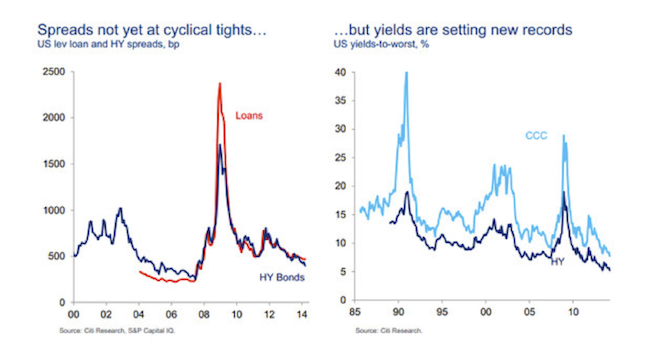

Financial markets are reaching a tipping point and typically that means most financial asset prices will decline.

Increasingly it seems developed countries will get closer to balanced budgets, tax offshore havens to do this, in coordination.

In short term I like treasuries 7yr+ and cash. i like my house, real assets.

it's worth considering the possibility of a crash, brief deflation, followed by high inflation shortly thereafter.  in essence that's my portfolio 7yr+ treasury will appreciate in a crash as will optionality of cash and trade weighted FX value of USDs. Then a quick shift to equities and assets that do well in an inflationary period. Inflation is such a vague word however. Not sure if i'm a realist or an optimist or a fool but we may see a very tight labor market in the US in coming years.

That global company profit margin reversion to the mean from 12% to 6% in addition to the transfer of wealth from an aging generation will mean, a lot, lot of money to spend.

What will do well? Labor. you can't print labor, you can't import it, there will be less of it. What do workers get paid in dollars. What will everyone want when SHTF, cash, the optionality of cash is increasing rapidly.

Many that have left the workforce will not return. Those that will, will take years to retrain.


Retail Store Space Closures 2005 - 2014

Does this look like a strong recovery? I know we shop at Amazon and online more but, this is a slowdown in spending.

Monday, April 21, 2014


i know where the smart money flow is going and i think i was there first...CLY

Thursday, April 10, 2014

How will the USD react when Renminbi (Chinese Yuan) is introduced into the global market

What will happen to the US Dollar when the Renmbinbi because the 4th major trade currency? Well let's look at the introduction of the EURO, the Euro share of trade after 2002, and the US dollar after 2002. Correlation isn't causation but....

Thursday, April 3, 2014

Keep an Eye on The Fed

With Bernank gone there are 3 more nominations pending for the 7 member FED.

http://www.stltoday.com/business/local/fed-board-member-stein-announces-resignation/article_dd68a39d-68c8-5d66-9b63-d68b83363609.html

Currently, there are three Obama nominations pending before the Senate including Stanley Fischer, a former head of Israel's central bank who Obama has nominated as vice chairman. Fischer would succeed Janet Yellen who in February became Fed chair, the first woman to hold the position in the Fed's 100 year history.

Just a guess here but I predict the FED will increasingly look like a 7 pack of Dove soap. ZIRP til mid-term elections. 

I'd love to see a graph of 'FED independence' at least from the rest of the political branch, bank influence, well you know. I have heard it from the horse's mouth, "Do you really think a bunch of poorly paid PhDs are making the decisions. The brightest are at the banks and they telegraph directions to the Fed." At least that is how it used to work. Ah financial repression, now what should a retiree invest in for some income...

Tuesday, March 25, 2014

How a China Slowdown/Collapse Could Play Out - 2014

China: Buys Treasuries Sells Treasuries
weakens Yuan strengthens Yuan
improves competitive stand point becomes less competitive, purchasing power increases relative to US Dollar
exposed to inflationary pressures if dollar weaker  deflationary
finances trade with US, more exports to US removes financing, less exports to US
large depreciating effect on USD since interest rates controlled at short end by FED with ZIRP policy in place
China Collapse
Real Estate values plunge; corporate defaults
mass exodus of capital
Much weaker Yuan
spike in inflation especially food & energy prices
government hikes interest rates & sells treasuries ->  China: energy/food value of imports surge, exports decline, trade deficit widens but total trade declines
Sells Treasuries
strengthens Yuan
becomes less competitive, purchasing power increases relative to US Dollar
deflationary; stabilizes input costs; Chinese companies forced to become more efficient; higher unemployment
removes financing, less exports to US
large depreciating effect on USD since interest rates controlled at short end by FED with ZIRP policy in place
end result: CHIMERICA = 
weaker dollar & yuan relative to world
higher interest rates on sovereigns
more competitive globally, lower labour costs
increased capacity utilization in China; yet higher unemployment as companies become more efficient 
increased CAPEX and FDI in US due to lower labor costs, weak currency, cheap local energy, stability, etc., lower unemployment, short term inflation spike, insufficient skilled labor pool
immediate result of China Collapse
stronger dollar; weaker yuan; stronger gold & silver 
collapse in treasury interest rates
spike in interest rates on China sovereigns; spike in defaults
market crashes, everywhere
some selling of treasuries by countries to stabilize currencies balanced by rush out of financial assets into safe havens

the future of banking?

Court reverses ruling on swipe fees in favor of banks


A U.S. appeals court on Friday struck down a district court decision that ordered the Federal Reserve to rewrite its rules governing fees that banks collect each time a debit card is swiped, a victory for the banking industry.
The ruling reverses a decision by U.S. District Court Judge Richard Leon, who said in July that the central bank improperly set the cap too high under pressure from the banking lobby. The Fed gave banks the thumbs-up to charge retailers as much as 21 cents a transaction, a few cents lower than the previous 23-to-25-cent charge per swipe.
More business news

Turkey blocks access to Twitter

Turkey blocks access to Twitter
Turkey restricted access to Twitter hours after its prime minister threatened to “root out” the social media.

Court reverses ruling on swipe fees in favor of banks

Court reverses ruling on swipe fees in favor of banks
Merchants argued that being charged more per transaction by banks leads to higher prices for consumers.

With heating plant, Armed Forces Retirement Home moves to develop

With heating plant, Armed Forces Retirement Home moves to develop
On the Old Soldiers’ Home, a historic heating plant goes up for lease.
Click here to subscribe.

The appeals court decision is a blow to merchants who have fought for nearly four years to limit the interchange fee, or “swipe fee.” Merchants have argued that consumers are the ultimate victims of these fees because the costs are usually passed on to them in the form of higher prices.
“The Fed ignored congressional intent and worked to shield debit card companies and big banks. A self-described victory for the banks usually results in higher costs for consumers,” said Mallory Duncan, general counsel of the National Retail Federation.
The banking industry applauded the appeals court’s decision, which will eventually funnel billions of dollars back into their coffers. Before the cap, interchange fees totaled nearly $17 billion in 2009, according to the Fed. Banks have argued that they need the fees to offset the cost of providing checking accounts and other services.
“Reasonable minds have prevailed,” said Richard Hunt, president and chief executive of the Consumer Bankers Association, a trade group. “Any further changes to the currently allowed interchange rates would only pile on the negative consequences for consumers. Consumers must come first in this process, not the bottom line of retailers.”
The appellate court said the Fed reasonably interpreted the 2010 Dodd-Frank financial overhaul law, which directed it to revise the way banks charge merchants for accepting debit cards. It determined that the Fed did its best to overcome the “ambiguity” of an amendment authored by Sen. Richard Durbin (D-Ill.) to limit swipe fees to the actual cost of processing debit card transactions.
Although the Fed proposed a cap of 12 cents per transaction, the final rule took an array of expenses into consideration, including the cost of fraud-prevention technology and equipment. The appeals court deemed inclusion of those costs to be in line with the spirit of the amendment.
While the pricing of interchange has dominated the conversation around the Durbin amendment, the rule also addressed the lack of competition in the payment system. The law said merchants must have multiple networks to conduct debit card transactions. The Fed required that each debit be processed on two independent networks for verification — one for PIN and one for signature.
Merchants argued that the law was supposed to give them more flexibility and choice. They wanted at least two signature options, which Leon permitted. The reversal of his ruling puts the kibosh on the argument.
Fed officials could not be reached for comment.
Despite being pleased with Friday’s outcome, Carrie Hunt, senior vice president of government affairs at the National Association of Federal Credit Unions, said the Fed’s rule imposes below-cost caps on interchange fees and fails to provide for a reasonable return.