If so, then the potential for negative feedback loops is high for, as growth
falls, the ex-post returns on the ‘financial borrowings’ will not be as high
as expected. And if, for whatever reason, interest rates then start to rise
(as they have lately been doing) then in a world in which the amount of
debt remains fixed, falling returns combined with rising servicing costs,
will mean that ‘somebody’ will have to eat an adjustment. That somebody
can be ‘capital’ (through a debt restructuring) though, more often than
not, the first port of call will be ‘labor’. Financial pressures will lead to
people being fired while remaining employees will be on the receiving
end of what was nothing but an attempt to get rich without working, by
capturing an undue rent created by the wrong cost of capital.
In other words, excessively low real rates seem to lead to rent seekers
(those close to the issue of new money) gorging themselves by bidding
on other people’s businesses and, then turning around when these assets
do not perform as expected and firing the employees. If this is the case,
then because zero interest rates trigger capital and labor misallocation,
we could perhaps conclude that they also end up being responsible for
a lower structural growth rate and a higher level of uncertainty for the
workforce (hence a fall in consumption, consumer confidence, birth
rates, etc.). This is how well-meaning central bankers and their zero
interest rate policies end up generating higher structural unemployment
rates, falling median incomes, and a huge increase in part time jobs.
Wednesday, July 29, 2015

Thursday, July 23, 2015
Math for Economists, The ideal economic system
I am not sure you can design “just right” growth. Perhaps you can in principle design a system of incentives such that businesses and individuals are more likely to take advantage of existing resources in the most productive way, and this must include financing mechanisms and property rights that maximize the social value of intellectual and physical property while at the same time maximizing incentives to create more productive intellectual and physical property. Some people argue that this means effectively creating the ideal Adam-Smith economy of an infinite number of competitive agents who are free to innovate, none of whom, including the government, are important enough to create institutional distortions. But you quickly realize that these are mutually contradictory goals: Eliminate all institutional distortions and you eliminate the ability to enforce property rights, and while this might increase the value of the some or most of the existing stock of assets, it would also probably reduce the future value of assets by, among other things, reducing innovation and investment aimed at improving capital stock. Eliminate all institutional distortions and you also eliminate rules that prevent businesses from lying or otherwise taking advantage of credibility generated by someone else, and if you reply that requiring total transparency might solve this problem, then you need an agent powerful enough to enforce transparency. Eliminate all institutional distortions and you make it impossible, or at least much harder, to protect commonwealth assets or to invest in projects that create externalities that are greater than the ability to capture those externalities — for example it is hard to capture the full social value of creating a first-rate primary education system, or enforcing an optimal pricing structure in any industry with returns to scale.
But once you agree that certain institutional distortions are good for long term value creation then you face the problem that the economy is a dynamic system with strong learning capacity, so that even if you could design the optimal set of institutional distortions, it would almost immediately become sub-optimal as the economy adapted and developed. This brings us back to Minsky when we think of the financial sector. The optimal financial sector must allow for enough value destruction to impose discipline, but not too much, and as the economy evolves from the agricultural economy of mid-19th-century California or the industrial economy of mid-19th Century New York to the information economy of early 21st century California or the creative/design economy of early 21st Century New York, is it even conceivable that the financial system that created the optimal amount of value destruction for the former will also create the optimal amount for the latter?
I will not even pretend that I know the answer, but remember that while there are clearly advantages to economic stability, and we know the many ways in which economic and financial instability can be extremely damaging to wealth creation, on the other hand in the past two centuries the periods of greatest technological innovation were almost always also periods of financial excess, asset bubbles, and foolish capital misallocation, and there is some evidence that from the Renaissance onwards, the fastest growing countries and regions in Europe and North America were never those that enjoyed the most stable financial sectors or even the most stable currency systems, but were in fact countries or regions that were relatively poorly served by their financial and monetary systems (for example few have been able to explain why the US was the most astonishingly productive country in a period of great economic advances for Europe and North America even though the US probably had the most unstable financial sector of any major rich country and a currency system that barely functioned to maintain the value of savings, and this outperforming economy and under-performing financial and monetary system held even against British colonies that were similarly endowed socially, legally, culturally, and physically, like Canada and Australia).
Monday, June 1, 2015
America's Nightmare as The Fallen Angel
Many fear that the current deflation outbreak will turn into a “vicious circle of deflation,” in which consumption is postponed and investment plans are curtailed in anticipation of lower prices. These behaviors contribute to a further drop in demand and additional reductions in prices.
Deflation is misunderstood
The first part is correct "Consumption is postponed and investment plans curtailed" but is it
1) in anticipation of lower prices
2) in anticipation of job losses, not getting social security payment, not saving enough for retirement
there are very different explanations for consumer behavior here.
One claims that future liabilities (expenses) will be lower if I wait, the other is based off expectations of future cash flow from my assets (in essence I've written down my social security assets and goodwill and must increase savings, lower expenses to meet future spending).
And is it really only fear itself and something far fetched or is it something that happens all the time all over the world?
Take what's being asked of the Greeks and their 'secure' retirement funds:
There's no confidence that the future will provide sufficient opportunities, there's no hope of a brighter tomorrow. The most powerful country the world has ever seen, slouched over on its mound of treasures, angry, divided and hopeless.
I agree with someone at the FED?
“If consumer behaviour is still being impacted by the experience of the financial crisis, the Great Recession, and the painfully slow recovery, then it is possible that the economy will not be as robust as many economic models would suggest, because the models do not take into account this behavioural change,” Eric Rosengren said.
How do you inspire confidence in the future? How does one unite a divided country and steer it towards a common productive goal? What has been the most effective way to redistribute wealth and lower inequality? What can bring back millions of manufacturing jobs in less than a year?
War...preferably between nations with great wealth that will purchase from the US, a repeat of WW2. perhaps SE Asia, Japan vs China? Maybe Saudi Arabia vs Iran? Maybe Europe vs Russia? the possibilities are endless.
The change in mindset (across the populace and as reflected in our congress, senate and white house) and wealth redistribution are the hardest tasks to accomplish and have a longer impact than the war itself.
Deflation is misunderstood
The first part is correct "Consumption is postponed and investment plans curtailed" but is it
1) in anticipation of lower prices
2) in anticipation of job losses, not getting social security payment, not saving enough for retirement
there are very different explanations for consumer behavior here.
One claims that future liabilities (expenses) will be lower if I wait, the other is based off expectations of future cash flow from my assets (in essence I've written down my social security assets and goodwill and must increase savings, lower expenses to meet future spending).
And is it really only fear itself and something far fetched or is it something that happens all the time all over the world?
Take what's being asked of the Greeks and their 'secure' retirement funds:
“Pensions should not be higher of 53% of the salary due to the financial situation of the social security funds.”Pension for a civil servant (director, 37 years of work) should come down to €900 from €1,386 today after the pension cuts during the austerity years.Pension for private sector – IKA insurer (37 years of work, 11,000 IKA stamps) and salary €2,300 should come down to €1,250 from €1,452 today after the austerity cuts. (examples* via here)
Of course, with the PSI in March 2012, Greece’s social security funds suffered a huge slap in their deposits in Greek bonds.
I agree with someone at the FED?
“If consumer behaviour is still being impacted by the experience of the financial crisis, the Great Recession, and the painfully slow recovery, then it is possible that the economy will not be as robust as many economic models would suggest, because the models do not take into account this behavioural change,” Eric Rosengren said.
How do you inspire confidence in the future? How does one unite a divided country and steer it towards a common productive goal? What has been the most effective way to redistribute wealth and lower inequality? What can bring back millions of manufacturing jobs in less than a year?
War...preferably between nations with great wealth that will purchase from the US, a repeat of WW2. perhaps SE Asia, Japan vs China? Maybe Saudi Arabia vs Iran? Maybe Europe vs Russia? the possibilities are endless.
The change in mindset (across the populace and as reflected in our congress, senate and white house) and wealth redistribution are the hardest tasks to accomplish and have a longer impact than the war itself.
Tuesday, April 14, 2015
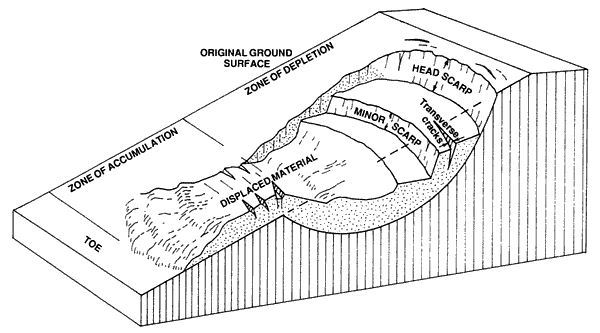
The next bubble: snow tension cracks
“Buybacks have been a tremendous support for US equities,” says Orrin Sharp-Pierson, a strategist at BNP Paribas. Referencing the efforts of aggressive central bank policy, he adds: “It’s been like quantitative easing directly on equities, $40bn-$50bn per month.
Companies have been a key source of support in recent years as investors have stepped back from buying equities. Since the start of 2010, companies have spent $3.3tn on share buybacks and dividends, as the US economy has recovered and investors sought blue-chip names with stable and growing returns.
Over the past five years, US investors have poured $301.5bn into domestic equity exchange traded funds, data from XTF.com shows. However, with redemptions of $411.1bn from US stock mutual funds over the same period, there has been a shortfall of more than $100bn between the two, according to the Investment Company Institute.
Negative Bond Yields in Europe via QE
Negative bond yields cause the value of liabilities to balloon and the adverse impact on the pension fund’s solvency will tend to outweigh any benefit from QE on the value of the asset.
Negative bond yields cause the value of liabilities to balloon and the adverse impact on the pension fund’s solvency will tend to outweigh any benefit from QE on the value of the asset.
The risk is that cheap borrowing will finance suboptimal investments, whether in fixed assets or expensive share buybacks in a frothy equity market. At the same time the debtors’ paradise keeps zombie banks afloat and allows them to roll over the debts of zombie companies. That in turn holds back productivity growth.
US QE
China debt-fueled expansion
Monday, January 5, 2015
This ghost that runs after you, my brother, is more beautiful than you; why do you not give him your flesh and your bones?
"Higher yet than the love of human beings I esteem the love of things and ghosts. This ghost that runs after you, my brother, is more beautiful than you; why do you not give him your flesh and your bones? " - Nietzsche
This ghost that runs after me,
My brother, has caught me
My flesh and bones, my daughter
You are beyond me, more beautiful
An evolution and a leap ahead
Still warm from the blaze of the eternal
Zlatica defying the Fates
Ascending from the realm of the impossible
From ghost to flesh
Hours from the greatest country on earth
The streets of my youth will forever be memories
I am banished and excommunicated in modern times
I have no political enemy, the city itself warns me
Plagued with faceless, warped and savage brothers
Never to hold my grandmother again
Or to introduce her to her grand-daughter
This ghost that runs after me,
My brother, has caught me
My flesh and bones, my daughter
You are beyond me, more beautiful
An evolution and a leap ahead
Still warm from the blaze of the eternal
Zlatica defying the Fates
Ascending from the realm of the impossible
From ghost to flesh
Hours from the greatest country on earth
The streets of my youth will forever be memories
I am banished and excommunicated in modern times
I have no political enemy, the city itself warns me
Plagued with faceless, warped and savage brothers
Never to hold my grandmother again
Or to introduce her to her grand-daughter
Tuesday, December 16, 2014


Thursday, October 9, 2014
O
What my eye did when #Ebola hit dallas pic.twitter.com/V41mwTWukP
— October 6 (@Tank_2015) October 9, 2014
Subscribe to:
Posts (Atom)